By Kristi Niemeyer
On the edge of memory is my mother in the late 60s, listening to that bold, sassy sound of Herb Alpert and the Tijuana Brass. Phonograph cranked up (yes, it was the age of vinyl) to “A Taste of Honey.”
Although he disappeared from my soundtrack in the ’70s, the influence of the record company he co-founded with Jerry Moss – A&M Records – was omnipresent. Carol King, Cat Stevens, Joe Cocker, Sting, Fairport Convention, Peter Frampton, and Paul Desmond were just a few of the artists in the A&M stable.
The man who will blow his horn in Whitefish and Bozeman this month has left an indelible mark on the music world, where his influence as a producer, musician and philanthropist are unrivaled.
“Artists have to have courage, but it goes a little further,” Alpert said in a recent telephone interview. “Timing plays a big part. Timing has definitely been on my side. I couldn’t have started A&M in today’s world.”
At almost 80, timing is still on Alpert’s side. He earned his ninth Grammy in 2014 for last year’s release, Steppin’ Out, and was inducted into the Grammy Hall of Fame for “Wonderful World,” a song he co-wrote in 1959 with Sam Cooke and Lou Adler. In 2013, he was invited to the White House to collect the nation’s highest award for artists, a National Medal of Arts.
After seven decades, Alpert’s trumpet is less feverish, more subtle and still enormously confident. He plays with a quiet grace and curiosity.
“The thing that sparks us”
“A song can go anywhere every night” one of his longtime band members said recently.
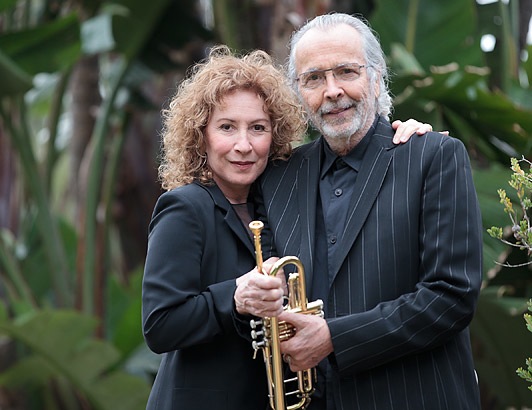
It’s apparent, watching Alpert play with his wife, world-class singer Lani Hall, and his band of eight years, that he relishes the surprises that show up when they play together.
“That’s the fun of it all – it’s very important that everybody can do what they want to do,” said Alpert. “That’s the thing that sparks us.”
Of course, this is a quintet of masterful musicians – which underscores one of Alpert’s mottos: “Before improvisation comes discipline.”
His band includes pianist and composer Bill Cantos, bassist Hussain Jiffry and drummer and percussionist Mike Shapiro.
“We know the chords, the melodies, the lay of the land, and we know where we can go astray,” he says. “The old timers in jazz – and I knew a lot of them – said, ‘if you can’t improve on a song, don’t mess around with it.’”
Alpert’s re-imagining of “Chattanooga Choo Choo” is a prime example. “I took an electronic groove by my nephew, Randy Badazz Alpert, put on to it my style, my jazz, added the elegant strings of Eduardo del Barrio, so we had three elements going at the same time.”
The sound is definitely not Glenn Miller. “The original was a nice recording. Why do it again?”
That spirit of adventure animates Alpert. He’s an accomplished artist, whose totemic sculptures grace his six-acre beachfront estate in Malibu. His abstract paintings, including his recent “Coffee Series,” are lauded as “quietly exuberant, spontaneous” by art reviewer Scarlet Cheng, and are part of collections worldwide.
Alpert finds “a tremendous amount of freedom” in the artistic process, whether it’s painting, sculpting or making music. “I look for that. I just try to be the best I can be.”
For him, the process is more emotional and intuitive than intellectual. “If you think too hard about it, you can miss it.”
In the studio, whether working on a song or a painting, “When it touches me, I stop. I’m not a lint picker. I don’t over-analyze.”
That’s a personality type, a gift, I suggest. “It’s a gift but it can be developed too,” he replies.
“Look for your own voice”
In addition to his own phenomenal output (five Billboard No. 1 hits, 14 platinum and 15 gold albums) he’s worked with, and helped shape the careers of, many of the most prominent musicians of the ’70s and ’80s.
He believes the music business today, with its emphasis on digital production, tends to sterilize the product. “Technology can be a hindrance,” he says. “It creates too many choices.”
“Use the intellect to close that door,” he suggests. “Use instinct to make decisions.”
The objective, whether you’re a musician, painter, sculptor, dancer or poet, is “to continue to look for your own voice. It’s a never-ending pursuit – you can always hone it.”
As a young player, he tried to emulate the great trumpeters of his time. “I came to the conclusion, who wants to hear that? What do I sound like, how to I get the most out of my thing?”
Seven decades later, his new recording continues to coax the most out of “that thing,” whether he’s twining his soulful trumpet with piano, strings and his wife’s lustrous voice in “All I Have to Do Is Dream,” offering his sensuous take on Cole Porter’s “Begin the Bequine,” or evoking the familiar Latin inflections of “Spanish Harlem.”
“People respond to emotional stuff,” he says.
“She has magic”
Alpert met his wife, Lani Hall, when auditioning Brasil ’66 as the opening act for the Tijuana Brass. She was the lead vocalist, and her distinctive voice graced hits like “Mas Que Nada,” “Day Tripper” and “The Fool on the Hill.”
“There was something about her I really liked,” he told a reporter for the Orange County Register. “She was raw. She was from Chicago. She had this street sense, but was very, very intelligent.”
After nearly 41 years of marriage, he’s still enchanted. “I’m an early riser, 6, 6:30 a.m. I go into the studio and paint, sculpt, practice my horn,” he says. “I’m always anxious to get back into the room and see her, see how she slept, how she’s doing. Is that too much, too sentimental?” he asks.
Hall, a musical force in her own right, has recorded nearly two-dozen albums in three languages, and earned two Grammy Awards – the most recent as co-producer with Alpert on Steppin’ Out.
Their marriage is a partnership and musical collaboration, as much the pulse of Alpert’s life as his own creativity. Over four decades, he’s learned to appreciate the differences between men and women. “I very consciously try to look at life from her point of view, not just mine.”
“When I started doing that,” he says, “we got closer.”
Hall sings four songs on the current album, and is touring with Alpert and his band to 15 cities this fall, including Whitefish and Bozeman.
“She’s my best friend,” he says. “She’s the one who makes my life hum. She has magic.”
Arts education: “It’s a win/win”
Alpert and Moss sold A&M in 1989 for a purported $500 million. Alpert used some of his vast wealth to establish a charitable foundation that has given away $130 million to artists, arts education, and projects and organizations that promote “compassion and well-being.”
The annual Herb Alpert Award in the Arts disperses $75,000 apiece to five mid-career artists, typically those creating edgy, non-commercial work.
“You’re supposed to take risks,” he says of artists. “That’s your gig in life.”
It’s an area where public support for the arts has virtually evaporated. “I don’t think we’re evolved enough as human beings to understand that there are other things in life besides making money.”
Education is a big recipient too, from UCLA, home of the Herb Alpert School of Music, to the California Institute of the Arts and the Thelonious Monk Institute of Jazz. The foundation’s gift of $5.5 million is credited with resuscitating the Harlem School of the Arts last year.
“I had that opportunity when I was 8, in grammar school,” he recalls. “I took a music appreciation class and they had all these instruments spread out on a table. I picked up the trumpet and it obviously changed my life.”
For a shy kid, he adds, “it did a tremendous thing – the trumpet talked for me.”
He believes the arts should be a core subject for all schools, public and private. “To get better at art, you learn discipline, and that folds over into academics. It’s a win/win,” he says.
The arts can also help us learn to get along with each other. “You begin to appreciate your own uniqueness, and maybe you get a chance to appreciate the uniqueness of others. Then, maybe we can begin to solve some of the problems we’re facing.”
Alpert performs Nov. 18 at the Whitefish Performing Arts Center (406-730-2817 or singerandsimpson.com), and Nov. 19 at the Ellen Theatre in Bozeman (406-585-5885 or www.theellentheatre.com).